23.12.2025 • 27 min read
Investment in aviation business: creating and supporting a general aviation company in Switzerland
Switzerland has emerged as one of Europe's most attractive jurisdictions for aviation business investment, combining regulatory stability, strategic location, and a business-friendly environment.
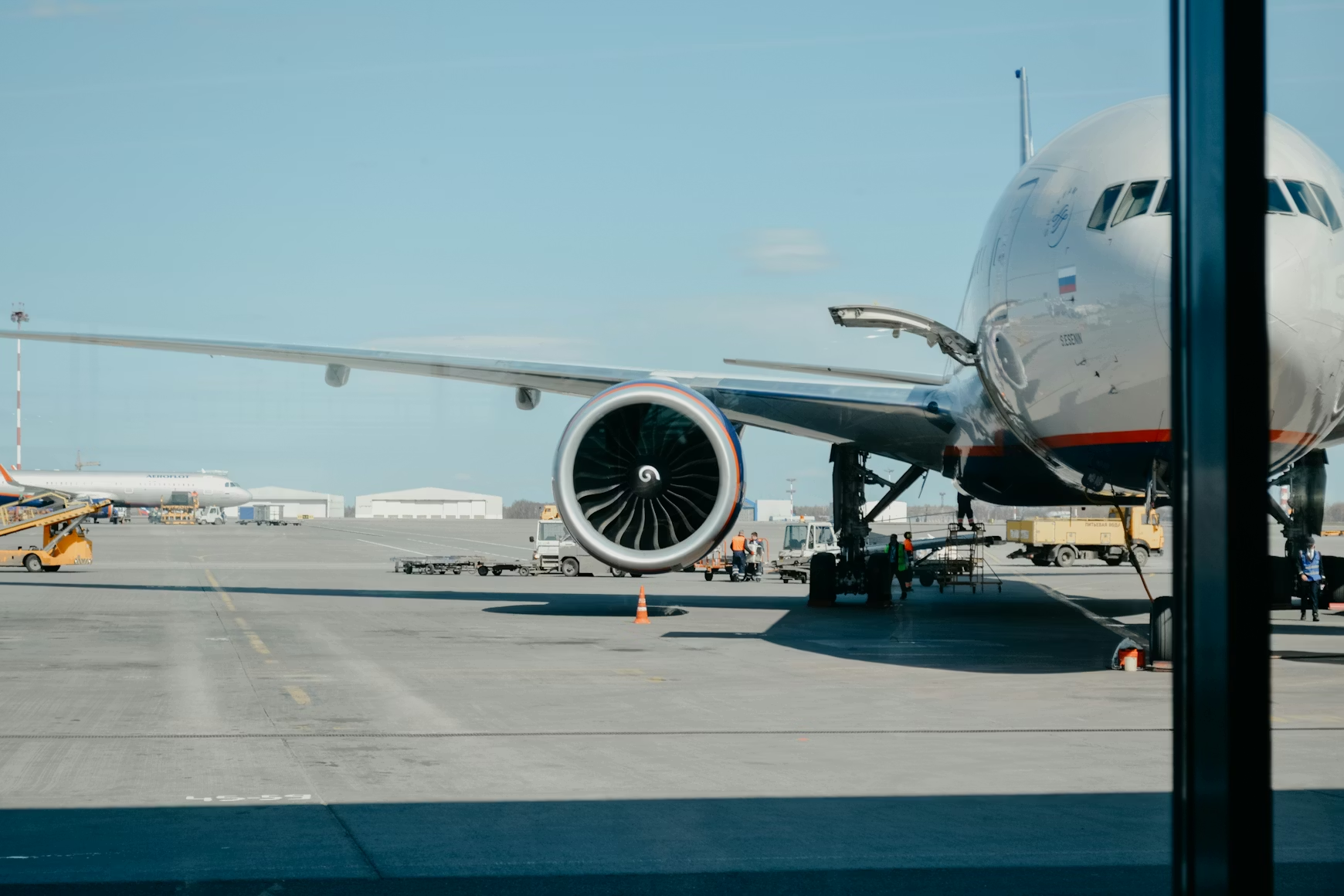

Switzerland has emerged as one of Europe's most attractive jurisdictions for aviation business investment, combining regulatory stability, strategic location, and a business-friendly environment. For international investors considering entry into the general aviation sector, understanding the complete framework—from company registration to operational licensing—is essential for successful market entry and long-term profitability.
"Over two decades of advising international clients on Swiss company formation, I've observed that aviation ventures require particularly meticulous planning. The regulatory framework is thorough, but investors who approach it systematically—with proper legal structure, adequate capitalization, and realistic timelines—consistently achieve operational status within the required timeframes." — Markus Pritzker
Why Switzerland is the ideal jurisdiction for investment in aviation business
Before detailing the registration process, investors must understand the strategic advantages that make Switzerland uniquely positioned for aviation ventures. The country's combination of geographic, economic, regulatory, and infrastructural factors creates a compelling investment case.
Key Advantages for Aviation Business in Switzerland
Geographic Position
Unparalleled access to European business and tourist centres.
Economy & Taxes
AAA-rated stability and a competitive corporate tax climate.
Workforce & Infra
Access to multilingual professionals and world-class airports.
Support & Innovation
Active funding for SAF, AviaTech, and U-space development.
Strategic location in central Europe
Switzerland's geographic position provides unparalleled access to European business and tourist centres. Zurich Airport connects to over 200 destinations worldwide, while Geneva serves as a major hub for business aviation, particularly for corporate executives and high-net-worth individuals traveling to international organisations and Alpine resorts.
Flight times from Zurich to major European capitals demonstrate this advantage: Paris (1 hour 27 minutes), Frankfurt (55 minutes), London (1 hour 45 minutes), and Milan (1 hour). This central positioning reduces operational costs and maximizes aircraft utilisation rates for charter and business aviation operators.
Stable economy and attractive tax climate
Switzerland maintains AAA sovereign credit ratings from all major agencies (Standard & Poor's, Moody's, Fitch) as of 2025, reflecting economic stability that protects long-term aviation investments. The country's current account surplus of 5–8% of GDP and moderate government debt provide a secure foundation for capital-intensive aviation ventures.
Corporate taxation varies by canton, with effective rates ranging from approximately 11.9% in Zug to 24.4% in higher-tax jurisdictions. For aviation companies, the federal corporate income tax rate is 8.5% (effective 7.83% on pre-tax profit due to deductibility), combined with cantonal rates. Zurich's effective rate is approximately 19.6%, while Geneva's is about 14.7%.
The standard VAT rate is 8.1%, applicable to most aviation services. VAT registration becomes mandatory when Swiss taxable turnover exceeds CHF 100,000 per year. This tax structure, combined with Switzerland's network of double taxation treaties with over 100 countries, enables efficient international operations and profit repatriation.
Highly qualified workforce and developed infrastructure
The Swiss aviation sector employs approximately 34,000 professionals and generates CHF 15 billion annually. The labour market offers access to multilingual pilots with EU licences, certified aircraft maintenance engineers, and air traffic controllers trained to EASA standards.
Educational institutions such as the Swiss Aviation Training Center and Zurich University of Applied Sciences provide specialised aviation management, piloting, and aerospace engineering programs. The sector plans to add 5,000 jobs by 2030, indicating sustained growth and talent availability.
Infrastructure quality is exceptional. Zurich Airport handled over 31 million passengers in 2024, while Geneva serves as a primary business aviation gateway. Both airports offer dedicated FBO (Fixed Base Operator) facilities, VIP terminals, and 24-hour customs clearance for private aircraft operations.
Government support and focus on innovation (SAF, AviaTech)
The Swiss government actively supports aviation innovation through multiple channels. The Federal Office of Civil Aviation (FOCA) implements a funding strategy prioritizing sustainable aviation fuel (SAF) development, with the first eSAF pilot plant receiving a CHF 4.4 million government grant in 2024.
Switzerland will implement the EU ReFuelEU Aviation regulation from January 2026, requiring at least 2% SAF blending at Geneva and Zurich airports, creating investment opportunities in SAF production and distribution infrastructure.
Digital aviation innovation receives support through U-space airspace development in Zurich, integrating drones using automatic services with full airspace visibility targeted by 2030. The Swiss Innovation Agency (Innosuisse) funds AviaTech projects in aviation software, control systems, and urban air mobility technologies.
Switzerland participates in approximately 180 international aviation treaties, supporting cross-border operations.
Prospects for the general aviation and private air travel market in Switzerland
The Swiss general aviation market demonstrates stable growth with specific characteristics that inform investment decisions. Understanding market dynamics, demand drivers, and emerging niches is essential for positioning new ventures.
Switzerland's aircraft market revenue is projected at approximately USD 505 million in 2025, representing a peak before expected consolidation. General aviation accounts for 68% of aircraft movements in Switzerland, dominated by small aircraft operations serving business and leisure segments.
European business aviation, including Switzerland, forecasts modest growth at +0.3% annual increase in movements for 2025. This reflects market maturity, with focus shifting from expansion to reliability, operational efficiency, and carbon footprint reduction.
Key demand drivers include the growing number of High Net Worth Individuals (HNWIs) in Switzerland—approximately 1 million individuals with net worth over $1 million as of 2024—and corporate mobility needs. Switzerland leads globally in average wealth per adult at $687,166, creating sustained demand for private aviation services.
Promising Niches in Swiss General Aviation
| Niche | Investment Level | Profitability Potential | Key Trends |
|---|---|---|---|
| Business Charters | Moderate (CHF 5-15M for 3-5 aircraft fleet) | Stable with +0.3% annual growth; premium pricing | UHNWI demand; fleet renewal; SAF compliance costs |
| MRO (Maintenance, Repair, Overhaul) | Moderate to high (infrastructure and certification) | Steady demand linked to fleet renewal | EASA Part-145 certification; SAF-compatible infra |
| AviaTech (Software and Systems) | High (R&D intensive) | High growth potential in AI, analytics, navigation | EU "Fit-for-55" policy; hybrid/eVTOL adoption |
| Ground Handling (FBO) | Moderate (facility and equipment) | Linked to traffic volumes; infrastructure expansion | SAF infrastructure; passenger services; compliance |
| Unmanned Systems (UAS/UAM) | High (emerging technology) | Long-term potential in urban air mobility | eVTOL development; regulatory support for UAM |
| Niche | Investment level | Profitability potential | Key trends |
|---|---|---|---|
| Business charters | Moderate (CHF 5-15M for 3-5 aircraft fleet) | Stable with +0.3% annual growth; premium pricing for time efficiency | UHNWI demand; fleet renewal with fuel-efficient jets; SAF compliance costs |
| MRO (Maintenance, Repair, Overhaul) | Moderate to high (infrastructure and certification) | Steady demand linked to fleet renewal; pressured by rising SAF costs | EASA Part-145 certification; SAF-compatible infrastructure requirements |
| AviaTech (software and systems) | High (R&D intensive) | High growth potential in AI, real-time analytics, advanced navigation | EU "Fit-for-55" policy; hybrid/eVTOL adoption; connectivity solutions |
| Ground handling (FBO) | Moderate (facility and equipment) | Linked to traffic volumes; benefits from infrastructure expansion | SAF infrastructure investment; passenger services; environmental compliance |
| Unmanned systems (UAS/UAM) | High (emerging technology) | Long-term potential in urban air mobility and delivery services | eVTOL development; regulatory support for UAM; urban transport innovation |
The European general aviation market is expected to grow at a CAGR of approximately 6.3% through 2025, supported by fleet renewal, SAF adoption, and advanced avionics integration. Switzerland's position within this market benefits from regulatory harmonization with EASA standards and strong domestic demand fundamentals.
How to start and register an aviation business in Switzerland: step-by-step plan
Launching an aviation company in Switzerland requires managing a structured regulatory process. The following framework outlines the essential stages from initial planning to operational readiness.
Aviation Company Registration Process
Business Plan & Niche Selection
Canton & Legal Form Selection
Commercial Register Registration
Bank Account Opening
FOCA Licensing Preparation
Step 1: business plan development and market research
The foundation of any aviation venture is a thorough business plan that addresses operational, financial, and regulatory requirements. This document serves multiple purposes: internal strategic guidance, FOCA application support, and investor/lender presentation.
Key components include market analysis (target customer segments, competitive market, pricing strategy), operational plan (aircraft type and quantity, crew requirements, maintenance arrangements), financial projections (startup costs, operating expenses, revenue forecasts for 3-5 years), and regulatory compliance roadmap.
For business aviation, typical startup costs range from CHF 5-15 million for a fleet of 3-5 aircraft, including aircraft acquisition or lease deposits, insurance, initial working capital, and licensing fees. MRO operations require significant infrastructure investment but lower aircraft capital requirements.
Step 2: organizational-legal form selection (AG vs. GmbH) and canton choice
Swiss company law offers two primary structures for aviation businesses: Aktiengesellschaft (AG) and Gesellschaft mit beschränkter Haftung (GmbH). The choice significantly impacts capitalization requirements, governance structure, and operational flexibility.
AG (stock corporation) requires minimum share capital of CHF 100,000, with at least CHF 50,000 paid at incorporation. It features formal governance with a board of directors, general meeting, and auditors. Shares are freely transferable, and shareholder identities can remain undisclosed. This structure suits larger aviation operations or those planning external investment.
GmbH (limited liability company) requires CHF 20,000 fully paid capital at registration. Management is simpler, directly by partners, with fewer formalities and no mandatory board. Share transfer requires notarized consent, and shareholders must be publicly registered. This form suits smaller operations or startups preferring simplified management.
Both forms provide limited liability. Each Swiss GmbH or AG must have at least one resident director with signatory authority. For aviation companies, AG is generally preferred due to higher capital requirements aligning with FOCA financial solvency expectations and greater flexibility for future growth.
Canton selection affects tax burden, regulatory environment, and operational costs. Zurich offers proximity to Switzerland's largest airport and extensive aviation infrastructure, with an effective corporate tax rate of approximately 19.6%. Geneva provides access to international organisations and Alpine tourism markets, with a rate near 14.7%. Zug offers the lowest tax rates (from 11.9%) but less aviation-specific infrastructure.
Step 3: legal registration and bank account opening
Company registration follows a standardized process through the cantonal Commercial Register. Incorporation requires notarized articles, capital deposit, and filing with the Commercial Register. The procedure requires:
-
Notarization of incorporation documents: Articles of association, shareholder agreements, and appointment of directors must be notarized by a Swiss notary. This typically costs CHF 1,500-3,000.
-
Capital deposit: Share capital must be deposited in a Swiss bank account opened specifically for this purpose. The bank issues a certificate confirming the deposit, required for registration.
-
Registered office: The company must have a physical address in Switzerland with a nameplate, lease agreement, and evidence of actual premises (not just a mailbox service).
-
Commercial Register filing: Submit notarized documents, capital deposit certificate, and proof of registered office to the cantonal Commercial Register. Processing takes 2-4 weeks depending on workload.
-
UID number: Upon registration, the company receives a unique identification number (UID) used for all official purposes.
Opening a corporate bank account requires passport, proof of residential address, and bank references for all shareholders and directors. Swiss banks conduct thorough due diligence, particularly for aviation companies due to anti-money laundering requirements. The process typically takes 2-4 weeks.
After registration, the deposited share capital becomes available for company use. Total registration timeline is typically 4-8 weeks from document preparation to operational bank account.
Step 4: preparation for FOCA licensing application
Before submitting to FOCA, the company must prepare full documentation demonstrating operational capability, financial solvency, and safety management systems.
Submit FOCA applications at least 30 days before commencing operations, including business plan and financials.
Required elements include:
- Detailed business plan outlining operational scope, target markets, and financial projections
- Aircraft list specifying type, registration, ownership/lease arrangements
- Crew qualifications with FOCA-issued pilot licenses and medical certificates
- Maintenance arrangements either in-house (requiring Part-145 certification) or contracted with certified organisations
- Insurance certificates covering liability, hull, and passenger coverage
- Safety management system documentation per EASA requirements
- Financial statements proving adequate capitalization and liquidity
For Air Operator Certificate (AOC) applications, AOC certification is multi-stage and often takes 9–18 months, depending on complexity and preparedness.
Regulation and legislation: FOCA's role in Swiss aviation
The Federal Office of Civil Aviation (FOCA) serves as Switzerland's primary aviation regulatory authority, overseeing all aspects of civil aviation safety, certification, and operational standards. Understanding FOCA's structure and requirements is essential for aviation business planning.
FOCA operates as a division of the Federal Department of Environment, Transport, Energy and Communications, headquartered in Bern with approximately 350 staff. The organisation maintains strict separation between safety-related activities (certification and supervision) and aviation policy formulation, ensuring regulatory independence.
Key functions include:
- Personnel licensing: Issuing and monitoring pilot licenses, air traffic controller certifications, and maintenance engineer qualifications according to EU Aircrew Regulation and ICAO Annex 1
- Aircraft certification: Approving aircraft registration, airworthiness certificates, and continuing airworthiness management
- Operator oversight: Supervising aviation companies through operating licenses based on technical, operational, and financial evaluations
- Airspace management: Coordinating with Swiss Air Force and Skyguide (air traffic control) for safe airspace use
- Safety standards enforcement: Conducting inspections, audits, and incident investigations
FOCA bases its regulatory framework on internationally agreed standards, primarily ICAO (International Civil Aviation Organization) conventions and EASA (European Aviation Safety Agency) regulations. Switzerland participates in EASA through bilateral agreements, ensuring regulatory harmonization with EU aviation markets.
The primary legislative acts governing Swiss aviation include:
- Federal Civil Aviation Act (21 December 1948, as amended): Establishes the legal framework for civil aviation operations, aircraft registration, and safety oversight
- Aviation Ordinance (AviO): Details implementation of the Civil Aviation Act, including ownership requirements and operational standards
- Federal Act on the Aircraft Records Register: Governs aircraft registration and ownership recording
Aircraft owners must meet Swiss nationality or residence conditions; FOCA may authorize exceptions for Swiss companies.
FOCA publishes procedures for aircraft entry and recording in the Swiss Aircraft Register.
For detailed requirements and procedures, investors should consult FOCA's official website at bazl.admin.ch.
Aircraft registers and ownership requirements
FOCA holds two aircraft registries, both of which are public:
-
Swiss Aircraft Register: All Swiss (HB) aircraft are mandatorily registered. The Swiss Aircraft Register mentions the name of the owner and the operator of the aircraft; however, such mention of ownership does not provide any proof of title.
-
Swiss Aircraft Record: An HB aircraft (already registered with the Swiss Aircraft Register) may be registered upon request of its owner, provided that it has an address for notices in Switzerland. As soon as an HB-registered aircraft is registered with the Swiss Aircraft Record, the Swiss legal system applies to such aircraft rules similar to those governing immovable property. An ownership interest, or any mortgage, is to be registered with the Swiss Aircraft Record.
There is no specific engine register in Switzerland. Engines can be registered with the Swiss Aircraft Record only in relation to a specific aircraft as an integral part of, or an accessory to, such aircraft.
Ownership eligibility: In accordance with Swiss law, the following are permitted to register an aircraft:
- Swiss citizens
- Foreign nationals with a long-term residence permit for Switzerland (e.g., type B residence permit or type C settlement permit). As a rule, the aircraft must be operated from Switzerland
- Trading companies or cooperatives that have their registered office in Switzerland and are entered in the Swiss commercial register
- Public-law corporations and institutions
- Associations established under Swiss law
FOCA may authorize the entry of an aircraft in the Swiss Aircraft Register if the aircraft is to be used for a longer period by a Swiss commercial aviation company, even if the registration conditions are not met.
Security interests, mortgages, fees, and deregistration
Registration fees and mortgages
Registration mark reservation is CHF 110; processing CHF 400–600; supervision fees scale with MTOW.
The fees charged by FOCA for the registration of an aircraft with the Swiss Aircraft Record depend on the maximum take-off weight of the aircraft (the maximum fee is 10,320 Swiss francs and the minimum fee is 195 Swiss francs).
For mortgage registration, fees depend on the secured amount (the maximum fee is 17,200 Swiss francs and the minimum fee is 385 Swiss francs).
The mortgage agreement must be made in writing and filed in original form, together with an official form that summarizes the main terms of the mortgage agreement. The form must contain:
- The designation of the aircraft as registered with the Swiss Aircraft Record
- The name, registered address, and contact details of the mortgagor and mortgagee
- The maximum secured amount including principal and interests (in Swiss francs)
- The rank of the mortgage
Deregistration and export
The deregistration request must be executed by the owner, irrespective of whether the aircraft is registered only with the Swiss Aircraft Register or also with the Swiss Aircraft Record. The aircraft will not be deregistered without the prior written consent of a mortgagee (if any). The aircraft will not be deregistered until the FOCA is in possession of the originals of the certificate of registration and the certificate of airworthiness of the aircraft.
The operator has various means to block the deregistration, such as applying for provisional measures aiming at protecting its right to use the aircraft or keeping the original board documents of the aircraft (in which event the FOCA is entitled to force the operator to return the original board documents).
Cape Town Convention
Switzerland has signed the Cape Town Convention (2001) and its Protocol but has not yet ratified it.
Necessary licences and permits for an aviation company
Operating an aviation business in Switzerland requires multiple licences and certifications, each addressing specific aspects of safety, operational capability, and regulatory compliance.
Air Operator Certificate (AOC) is the primary authorization for commercial air transport operations. FOCA issues AOCs following the ICAO 5-step certification process: pre-application, formal application, document evaluation, demonstration and inspection, and certification decision.
The AOC application requires:
- Detailed organizational structure with nominated key postholders (Accountable Manager, Safety Manager, Chief Pilot)
- Operations manual covering all operational procedures
- Safety management system documentation
- Proof of economic viability per EU Regulation 1008/2008, Article 4
- Evidence of adequate insurance coverage
- Demonstration flights and operational inspections
Timeline for AOC certification typically ranges from 9 to 18 months, depending on operational complexity and applicant preparedness.
Part-145 certification is required for organisations performing aircraft maintenance, repair, and overhaul. This certification demonstrates compliance with EASA continuing airworthiness standards and requires:
- Approved maintenance organisation manual
- Qualified technical staff with appropriate licences
- Adequate facilities, tools, and equipment
- Quality management system
- Regular FOCA audits and inspections
Aircraft certificates of airworthiness must be obtained for each aircraft in the fleet. FOCA issues these based on type certification and individual aircraft inspection, confirming compliance with safety standards.
Personnel licences include:
- Pilots and crew must hold FOCA-issued licences prior to commencing operations
- Aircraft maintenance engineer licenses for technical staff
- Air traffic controller licenses (if operating own control services)
Information provided is general in nature and does not replace professional consultation.
Insurance minimums and liability
The Ordinance on Aviation sets out the minimum insurance cover (for damage incurred by third parties on the ground) as an amount expressed in special drawing rights based on the maximum take-off weight of an aircraft. These amounts and weights are in line with Regulation (EC) No. 785/2004 of the European Parliament and of the European Council of 21 April 2004 on insurance requirements for air carriers and aircraft operators.
Liability for damage caused to third parties on the surface or in flight lies with the aircraft operator. The operator is described for such purpose as the person having the power to dispose of the aircraft, using the aircraft for its own account and at its risk, and exercising direct and effective control over the aircraft. The risk that the owner, lessor or financier qualifies as an operator for third-party liability purposes is, generally, remote but cannot be excluded (in particular in situations such as private flights or repossession).
Taxation of aviation business: key rates and fees in Switzerland
Understanding the tax structure is critical for financial planning and investment return calculations. Swiss aviation companies face federal, cantonal, and municipal taxes, plus specific aviation-related fees.
Main Taxes for an Aviation Company in Switzerland
| Tax Type | Rate | Notes |
|---|---|---|
| Federal Corporate Income Tax | 8.5% (effective 7.83%) | Flat rate on profit after tax; tax itself is deductible. |
| Cantonal/Municipal Corporate Income Tax | 11.9% - 19.6% | Combined effective rate. Varies by canton: Zurich ~19.6%, Geneva ~14.7%, Zug ~11.9%. |
| Value Added Tax (VAT) | 8.1% | Standard rate. Mandatory if turnover > CHF 100,000 annually. |
| Tax type | Rate | Notes |
|---|---|---|
| Federal corporate income tax | 8.5% (effective 7.83% on pre-tax profit) | Flat rate on profit after tax; tax itself is deductible |
| Cantonal/municipal corporate income tax | Varies by canton: Zurich ~19.6%, Geneva ~14.7%, Zug ~11.9% | Combined effective rate including federal tax; significant variation by location |
| Value Added Tax (VAT) | 8.1% standard rate | Applies to most aviation services; registration mandatory if turnover exceeds CHF 100,000 annually |
Corporate income tax combines federal and cantonal components. The federal rate of 8.5% applies uniformly across Switzerland. Cantonal rates vary significantly, creating opportunities for tax optimisation through strategic canton selection. Total effective rates range from approximately 12% to 24% depending on location.
VAT: Standard VAT in Switzerland is 8.1%. Under Swiss VAT law, a leasing transaction qualifies as a supply of goods; VAT treatment depends on where the aircraft is located when entering into and during the lease. Sale-and-leaseback may qualify as a VAT-exempt financial service if the agreement provides for mandatory title retransfer at lease-end.
VAT registration becomes mandatory when Swiss taxable turnover exceeds CHF 100,000 per year.
Additional aviation-specific fees include:
- Airport landing and parking fees (vary by airport and aircraft weight)
- Air navigation charges (based on aircraft weight and route distance)
- Noise charges (particularly at Zurich and Geneva airports)
- Environmental fees (increasing focus on emissions-based charging)
Tax optimisation strategies for aviation companies:
- Canton selection based on effective tax rates and operational requirements
- Holding company structures for aircraft ownership (potential for reduced cantonal taxation)
- Utilization of double taxation treaties for international operations
- Proper documentation of international flight segments for VAT zero-rating
Note that cantonal tax rates are subject to change, and specific circumstances may qualify for special regimes. Professional tax advice is essential for accurate planning and compliance.
Information provided is general in nature and does not replace professional consultation.
Customs and VAT on aircraft import and leases
As a matter of principle, goods entering Swiss territory—whether as part of a repossession process or otherwise—are subject to customs clearance, which generally entails paying import duties based on the aircraft weight and import VAT. Aircraft intended for private use in civil aviation may be exempted from import duties (but not VAT). Other exceptions or exemptions may be available (for both import duties and VAT), based, for example, on temporary import (Switzerland ratified the Istanbul Convention on Temporary Admission (1990)), specific customs regimes (such as inward processing) or, under certain circumstances, in the case of aircraft imported by air transport enterprises operating mainly on international routes.
The responsibility for customs clearance is primarily to the persons who have operational control over the aircraft (airline, owner or operator) at the time it enters Swiss territory and their representatives. The liability for the payment of import duties and VAT may extend to certain persons indirectly involved in the operation on a joint and several basis, depending on the circumstances of the case (including owner, consignee or freight forwarding agent).
The export of an aircraft from Switzerland is not subject to customs duties or VAT.
Common investor mistakes and how to avoid them
International investors entering the Swiss aviation market frequently encounter predictable challenges. Understanding these pitfalls enables proactive mitigation and smoother market entry.
Underestimating FOCA licensing timelines and complexity
The most common and costly mistake is unrealistic timeline expectations for AOC certification. Investors often budget 3-6 months when the actual process typically requires 9-18 months.
This underestimation stems from comparing Switzerland to jurisdictions with less rigorous oversight. FOCA's thorough evaluation process includes multiple stages: document review, facility inspections, crew competency assessments, demonstration flights, and safety management system validation.
Delays frequently occur due to:
- Incomplete or improperly formatted documentation requiring resubmission
- Insufficient evidence of financial solvency or insurance coverage
- Crew licensing issues (foreign licenses requiring validation)
- Maintenance organisation approval delays
- Safety management system deficiencies requiring correction
Mitigation strategy: Begin FOCA engagement during company formation, not after. Allocate 12-18 months for AOC certification. Engage experienced aviation consultants familiar with FOCA procedures. Prepare full documentation packages before formal application submission.
Incorrect canton selection regarding taxes and regulation
Canton choice significantly impacts long-term operational costs and regulatory environment. Investors often select based solely on tax rates, ignoring operational factors.
Zurich offers the highest concentration of aviation infrastructure, skilled workforce, and proximity to Switzerland's largest airport, but higher effective tax rates (~19.6%). Geneva provides access to international organisations and Alpine tourism markets with moderate rates (~14.7%). Zug offers minimal taxation (~11.9%) but limited aviation-specific infrastructure and workforce.
Mitigation strategy: Evaluate canton selection holistically, considering tax burden, workforce availability, proximity to operational bases, and local regulatory environment. For business aviation focused on Zurich Airport operations, the higher Zurich tax rate may be offset by operational efficiencies and reduced crew positioning costs.
Ignoring financial solvency requirements
FOCA requires proof of adequate capitalization and liquidity to sustain operations through normal business cycles and unexpected events. Minimum share capital (CHF 100,000 for AG, CHF 20,000 for GmbH) is insufficient for aviation operations.
Investors frequently underestimate working capital requirements, leading to:
- AOC application rejection due to inadequate financial resources
- Operational disruptions from cash flow shortages
- Inability to meet insurance premium payments
- Crew retention issues from delayed salary payments
Mitigation strategy: Prepare detailed financial projections covering 24-36 months of operations, including aircraft acquisition/lease costs, insurance, crew salaries, maintenance reserves, and operational expenses. Maintain liquid reserves equivalent to 3-6 months of operating costs. Document financial solvency clearly in FOCA applications with bank statements, credit facilities, and investor commitments.
Absence of local representative with aviation experience
Foreign investors often attempt to manage Swiss aviation regulations without local expertise, resulting in procedural errors, communication difficulties with FOCA, and extended timelines.
Mitigation strategy: Engage Swiss-based aviation consultants or legal advisors with FOCA experience from the outset. Ensure at least one Swiss resident director has aviation industry knowledge. Establish relationships with local service providers (maintenance organisations, FBOs, insurance brokers) early in the planning process.
Get consultation on opening your aviation company
Launching an aviation business in Switzerland requires managing complex regulatory requirements, substantial capital commitments, and detailed operational planning. Professional guidance significantly reduces timeline, minimizes costly errors, and ensures compliance with FOCA standards.
Our team provides full support for international investors entering the Swiss aviation market, including company formation and registration, FOCA licensing application preparation, financial structuring and capitalization planning, and ongoing operational compliance support.
Disclaimer: This article provides general information about aviation business formation in Switzerland and does not constitute legal, tax, or financial advice. Specific circumstances require professional consultation.
How long does it take to obtain an Air Operator Certificate (AOC) in Switzerland?
The AOC certification process in Switzerland typically requires 9 to 18 months from initial application to operational approval. This timeline depends on several factors: operational complexity (single aircraft type vs. multiple types), applicant preparedness (completeness of documentation), crew availability (FOCA-licensed pilots ready for demonstration flights), and FOCA workload.
The process follows ICAO's 5-step model: pre-application consultation (1-2 months), formal application submission and initial review (2-3 months), detailed document evaluation and facility inspections (3-6 months), demonstration flights and operational validation (2-4 months), and final certification decision and AOC issuance (1-2 months).
Delays most commonly occur during document evaluation when FOCA identifies deficiencies requiring correction and resubmission. Proactive engagement with FOCA during the pre-application phase significantly reduces overall timeline.
What is the minimum share capital for an aviation company (AG/GmbH)?
For a GmbH (limited liability company), the minimum share capital is CHF 20,000, which must be fully paid before registration. For an AG (stock corporation), the minimum is CHF 100,000, with at least CHF 50,000 paid at incorporation.
However, these legal minimums are insufficient for aviation operations. FOCA requires proof of adequate financial resources to sustain operations, typically interpreted as:
- Business aviation (3-5 aircraft): CHF 5-15 million total capitalization
- MRO operations: CHF 2-5 million depending on facility scope
- Larger commercial operations: Proportionally higher based on fleet size and operational complexity
The share capital must be deposited in a Swiss bank account before Commercial Register filing. After registration, these funds become available for operational use, including aircraft acquisition, insurance payments, and working capital.
What is the difference between investing in creating your own company and buying shares of public aviation holdings?
Creating a private aviation company in Switzerland offers direct operational control, potential for higher returns in niche markets, and ability to structure operations according to specific business strategies. However, it requires substantial capital (CHF 5-15 million minimum for viable business aviation operations), extensive regulatory compliance (AOC certification, ongoing FOCA oversight), operational expertise (crew management, maintenance, safety systems), and acceptance of concentrated risk.
Buying shares in public aviation holdings (such as Lufthansa Group, IAG, or Air France-KLM) provides portfolio diversification across multiple markets and aircraft types, professional management without operational responsibility, liquidity through stock market trading, and lower entry capital requirements. However, it offers no operational control, exposure to market volatility and macroeconomic cycles, and generally lower returns compared to successful private ventures.
The choice depends on investor objectives, risk tolerance, available capital, and aviation industry expertise. For investors seeking operational involvement and willing to commit substantial resources, private company formation offers greater potential returns. For those prioritizing liquidity and diversification, public equity provides simpler market access.
How promising are investments in sustainable aviation fuel (SAF) in Switzerland?
SAF investment in Switzerland shows strong fundamentals driven by regulatory mandates and government support. From January 2026, Switzerland requires 2% SAF blending for flights departing EU countries, increasing to higher percentages in subsequent years under the ReFuelEU Aviation regulation.
Government support includes:
- CHF 4.4 million grant to Metafuels and Paul Scherrer Institute for Switzerland's first eSAF pilot plant
- FOCA funding strategy prioritizing synthetic SAF development
- Integration of solar-produced SAF into commercial operations (Synhelion partnership with SWISS airline)
Market challenges include SAF prices 3-5 times higher than conventional jet fuel, limited production capacity requiring significant infrastructure investment, and technology risk in emerging production methods (e-fuels, solar synthesis).
Investment opportunities exist in SAF production facilities, distribution infrastructure at Swiss airports, and technology development for cost reduction. The sector suits investors with long-term horizons (5-10 years), tolerance for regulatory and technology risk, and interest in environmental impact alongside financial returns.
Near-term profitability is constrained by high production costs, but regulatory tailwinds and increasing airline commitments create favorable long-term prospects for well-positioned ventures.
What is the difference between the Swiss Aircraft Register and the Swiss Aircraft Record?
The Swiss Aircraft Register is mandatory for all HB-registered aircraft and mentions the owner and operator, but such mention does not provide proof of title. The Swiss Aircraft Record is optional and applies rules similar to immovable property; ownership interests and mortgages must be registered here to be legally effective.
Who is eligible to register an aircraft in Switzerland?
Eligible parties include Swiss citizens, foreign nationals with B or C residence permits (aircraft operated from Switzerland), Swiss trading companies registered in the Commercial Register, public-law corporations, and associations under Swiss law. FOCA may authorize exceptions for Swiss commercial aviation companies.
Is there a separate engine register in Switzerland?
No. Engines can only be registered with the Swiss Aircraft Record in relation to a specific aircraft as an integral part or accessory.
Can an operator block an owner's deregistration request?
Yes. The operator may apply for provisional measures to protect its right to use the aircraft or retain original board documents, which FOCA can order returned.
How does Swiss VAT (8.1%) apply to aircraft purchases, leases, and sale-leasebacks?
Aircraft purchases are subject to 8.1% VAT if the seller is a Swiss VAT payer, the aircraft is in Switzerland at transfer, and it is not exported afterward. Leasing qualifies as a supply of goods; VAT depends on aircraft location during the lease. Sale-leaseback is VAT-exempt if the agreement mandates title retransfer at lease-end.
What are the typical costs for FOCA registration and supervision?
Registration mark reservation costs CHF 110. Processing fees range from CHF 400 to CHF 600. Supervision fees scale with maximum take-off weight (MTOW), with aircraft registration fees ranging from CHF 195 to CHF 10,320 depending on weight. Mortgage registration fees depend on the secured amount, ranging from CHF 385 to CHF 17,200.
What insurance coverage is required for aviation operations in Switzerland?
The Ordinance on Aviation sets minimum insurance cover for damage to third parties on the ground, expressed in special drawing rights based on maximum take-off weight. These requirements align with EU Regulation 785/2004. Liability for damage lies with the aircraft operator, defined as the person with power to dispose of the aircraft, using it for their own account and at their risk, and exercising direct control.
How does Switzerland's participation in international aviation treaties benefit operators?
Switzerland participates in approximately 180 international aviation treaties, facilitating cross-border operations, mutual recognition of certifications, and simplified regulatory compliance for international flights. This treaty network provides Swiss-registered aircraft with broad operational access and reduces administrative barriers for international aviation service companies.
What are the key differences between AG and GmbH for aviation companies?
AG requires CHF 100,000 minimum capital (CHF 50,000 paid at incorporation), offers formal governance with a board of directors, allows undisclosed shareholders, and suits larger operations or those seeking external investment. GmbH requires CHF 20,000 fully paid capital, features simpler management directly by partners, requires publicly registered shareholders, and suits smaller operations preferring simplified administration. For aviation companies, AG is generally preferred due to alignment with FOCA financial expectations and operational flexibility.
What role does the Swiss Innovation Agency play in aviation technology development?
The Swiss Innovation Agency (Innosuisse) funds AviaTech projects in aviation software, control systems, and urban air mobility technologies. This support extends to digital aviation innovation, including U-space airspace development in Zurich for drone integration and automatic services with full airspace visibility targeted by 2030. These initiatives create investment opportunities in aviation technology and innovation-driven ventures.
How does the Cape Town Convention affect aircraft financing in Switzerland?
Switzerland has signed the Cape Town Convention (2001) and its Protocol but has not yet ratified it. Until ratification, the Convention's international registry for aircraft objects and standardized security interests do not apply directly to Swiss-registered aircraft. Investors should structure financing arrangements according to Swiss domestic law, particularly the Swiss Aircraft Record for mortgage registration and security interests.

30.12.2025
Real estate lawyers in Switzerland: expert support for your transactions and investments
Read Moreabout Real estate lawyers in Switzerland: expert support for your transactions and investments
30.12.2025
Expert property & real estate lawyers in Switzerland for foreign investors
Read Moreabout Expert property & real estate lawyers in Switzerland for foreign investors